
Sourcing Oral Care Devices for Russia & the EAEU: A Market Entry Guide for Brands
Russia and the Eurasian Economic Union are among the most underserved oral care markets for foreign brands — and simultaneously among the most misunderstood. Buyers hear "difficult market" and stop there, leaving a market of roughly 180 million consumers to domestic brands and a handful of confident importers.
The obstacles are real: certification is mandatory, labeling must be in Russian, and logistics have shifted substantially in recent years. But they’re all known, documented obstacles. That means they can be planned for.
This guide covers what a brand actually needs to handle to sell electric toothbrushes and water flossers in the EAEU, and how to structure the sourcing side so the paperwork doesn’t sink the launch.
What the EAEU Market Actually Rewards
Start with consumer preference, because it determines the product you should source — not the other way around.
| Preference | What It Means for Your Spec |
|---|---|
| Durability over novelty | Buyers expect a device to last; build quality rates higher than feature count |
| Simple, legible controls | Fewer modes with clear physical buttons often outsell app-connected complexity |
| Value at mid-tier pricing | Premium positioning works, but only with visible build quality to justify it |
| Strong preference for countertop flossers | Larger bathrooms and household use favor countertop models over compact portables |
| Full localized documentation | Russian-language manuals are expected, not a nice-to-have |
Two practical implications:
Countertop water flossers are a stronger entry product than portables in this market. Our portable vs countertop comparison covers the technical differences — for the EAEU, the countertop’s build-heaviness aligns with buyer expectations.
Rugged simplicity sells. A device with five clearly-labeled pressure settings and a sturdy hose beats a Bluetooth-connected unit with an app that isn’t localized.
Step 1: Certification (EAC) — Plan It First, Not Last
Every electric oral care device sold in the EAEU requires EAC conformity. For this product category the applicable technical regulations are typically:
- TR CU 004/2011 — Low Voltage Equipment Safety
- TR CU 020/2011 — Electromagnetic Compatibility
Certification is issued by an accredited body within the EAEU, with testing at an accredited laboratory, and documentation is issued in Russian. Two important structural facts:
- Longer lead time than CE — plan on roughly 4–8 weeks, sometimes more, and build it into your launch calendar.
- The applicant is generally an EAEU-registered entity. This is the detail that derails most first-time launches: a foreign brand usually cannot be the certificate holder directly. You typically need a local importer or authorized representative as the applicant.
Get this wrong and you have product in a warehouse that cannot legally be sold.
Our certification guide covers the full multi-market picture; for Russia specifically, the operating rule is: secure your local legal entity or importer first, then start certification.
Step 2: Product Adaptation for the Market
These are small items individually, and each one can block a shipment.
| Item | Requirement |
|---|---|
| Voltage | 220–240V / 50Hz for mains-powered countertop units |
| Plug type | Type C / F (Europlug) for mains devices; chargers must match |
| Language | Russian user manual, labeling, and packaging text |
| Battery performance | Lithium cells perform poorly below 0°C — relevant for unheated logistics chains |
| Packaging durability | Longer, less predictable transit means stronger cartons |
That battery point is worth expanding. Lithium-ion capacity drops noticeably in cold conditions, and EAEU distribution involves long overland legs. A device that arrives with a drained battery generates "defective" claims at the marketplace — damaging your seller rating before you’ve sold your first thousand units.
The fix is a specification decision: require a charge state of roughly 50% for shipping, and confirm the battery protection circuit prevents deep discharge during storage. Our battery comparison explains why Ni-MH sometimes makes sense in cold-chain-exposed product lines.
Step 3: Labeling and Documentation
Russian-language labeling is mandatory, and marketplace listings are typically checked against the physical product.
What must be localized:
- Product name and model
- Manufacturer name and address
- Country of origin
- EAC mark
- Technical parameters (voltage, power, IP rating)
- Warnings and safety instructions
- Usage and maintenance instructions
What buyers commonly forget: the manual is where localization failures matter most. A device that works perfectly but ships with an English manual generates returns and negative marketplace reviews. Budget for translation into Russian and print the manual as part of the packaging order — not as a separate step later.
Also confirm your packaging artwork reserves space for the EAC mark and the importer’s details. Retrofitting that onto finished packaging means either a sticker (acceptable, but cheap-looking) or a reprint (expensive).
Step 4: Logistics and Import Structure
Practical structure for a brand selling into the EAEU:
| Element | Typical Approach |
|---|---|
| Importer of record | Local EAEU entity — often your distributor or a service partner |
| Customs documentation | Commercial invoice, packing list, EAC conformity documents, contract |
| Route | Rail and road freight via EAEU-border entry points dominate; sea routes exist but are longer |
| Typical transit | Varies significantly; plan conservatively and add buffer |
| Payment structure | Negotiate in writing before production — see below |
Two scheduling realities to design around:
- Winter logistics are slower. Cold-weather transport adds lead time and creates the battery performance risk noted above. Don’t schedule a first shipment to arrive in January if you can avoid it.
- Customs clearance time is not predictable to the day. Build buffer into your marketplace restock planning — running out of stock on Ozon or Wildberries costs you ranking, not just sales.
On payment structure: cross-border settlement arrangements change, and they affect your cash flow and risk. Agree on the mechanism in writing at the contracting stage, before production begins, rather than discovering constraints when the deposit is due. Note that the standard 30/70 deposit structure is normal; a factory demanding full payment upfront because the destination is Russia is signalling a risk-assessment problem you should discuss openly.
Step 5: Choosing Your Channel
The EAEU’s dominant consumer channels are marketplaces, not traditional retail. Principal platforms include Ozon, Wildberries, and Yandex Market, alongside specialized distributors and pharmacy chains for health-positioned products.
| Channel | Best For | Sourcing Implication |
|---|---|---|
| Marketplaces (Ozon, Wildberries) | Reaching consumers directly at speed | Strong packaging and photography matter enormously; ratings are fragile |
| Distributors | Volume, lower marketing burden | Lower margin; confirm they hold certification capability |
| Pharmacy chains | Health-positioned devices | Often requires additional documentation and packaging standards |
| Offline electronics retail | Established brand presence | Higher barrier; typically requires a local track record |
For a first entry, marketplaces plus one distributor is a workable combination: the distributor provides the importer structure and certification pathway, while marketplaces build brand awareness.
Marketplace-specific sourcing notes: retail packaging photos and carton quality directly affect returns and ratings. A damaged box shows up in customer photos. Specify a stronger carton for this market and ask for a drop-test standard.
Working With Your Manufacturer
Not every Chinese oral care factory can support an EAEU launch well. Ask these before you commit:
- "Have you exported to Russia or the EAEU before? Can you show experience with EAC documentation?"
- "Can you produce a Russian-language manual and localized packaging? What’s the MOQ for that?"
- "Can the product be configured for 220–240V with Type C/F plugs?"
- "At what charge state do you ship lithium batteries, and what’s the storage discharge protection?"
- "Can you help coordinate with an EAEU certification body, or provide the technical files they’ll need?"
- "What carton grade do you use, and can you upgrade it for long transit?"
- "What’s your lead time for a Russian-market configuration versus a standard one?"
Question 2 is the most commonly underestimated. Localized packaging and manuals change your MOQ structure, and depending on how you structure your supply chain — see our OEM/ODM comparison and quoting guide for how MOQ, lead time and pricing interrelate — it might be the factor that sets your minimum order.
A Realistic Timeline for a First EAEU Launch
| Phase | Duration | Notes |
|---|---|---|
| Market research and product selection | 2–4 weeks | Define channel before spec |
| Manufacturer selection and sampling | 3–6 weeks | Include a sample tested in cold conditions |
| EAEU entity / importer arrangement | 2–6 weeks | Can run in parallel with sampling |
| EAC certification | 4–8 weeks | Starts once samples and entity are ready |
| Localized packaging and manual | 2–4 weeks | Runs parallel to certification |
| Production | 3–5 weeks | Post-approval |
| Freight and clearance | 4–8 weeks | Longer in winter |
Realistically, 5–8 months from decision to first saleable inventory. Brands that compress this usually do so by cutting certification or localization corners — and then lose the goods or the ratings.
The Bottom Line
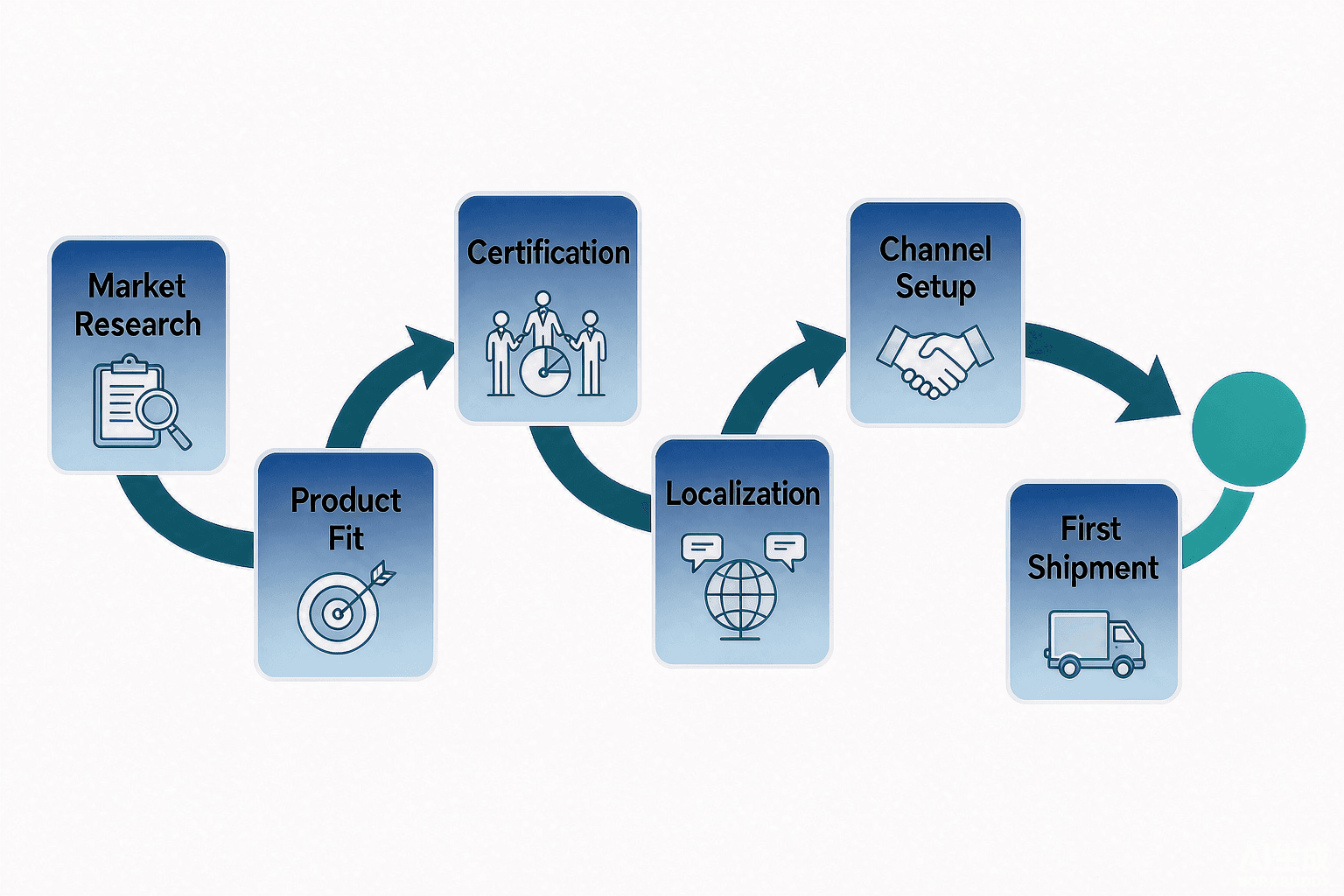
Russia and the EAEU aren’t a difficult market so much as a market with sequential requirements: entity first, then certification, then localization, then logistics. Each step is documented and achievable. The failures come from trying to run them out of order.
The brands that succeed here tend to be the ones that treated the market entry as an engineering project rather than a sales opportunity — and chose a manufacturer who understood that.
Besman manufactures electric toothbrushes and water flossers in 220–240V configurations with Type C/F plug options for EAEU markets. We supply the product and the technical documentation you’ll need when working with your local certification body and importer. Contact us to discuss your EAEU product plan.