
Portable vs Countertop Water Flosser: Which Design Should Your Brand Stock?
Adding a water flosser to your brand lineup is a smart move. The global market is growing fast, and consumers are swapping string floss for water pressure. But the first decision you’ll face is the one that determines your entire supply chain: portable or countertop?
Pick the wrong design for your market, and you’re stuck with slow-moving inventory and a product that doesn’t fit your customers’ bathrooms — literally.
Here’s how the two designs differ at the engineering level, which markets they fit, and what to prioritize when sourcing.
The Core Difference: Tank Size and Pressure
At the component level, the difference between portable and countertop comes down to two things: water capacity and pump power. Everything else — nozzle design, IPX rating, charging method — is secondary.
| Feature | Portable Water Flosser | Countertop Water Flosser |
|---|---|---|
| Water Tank Capacity | 150–250ml (1 fill per use, often mid-session refill) | 600–1000ml (covers a full family session) |
| Water Pressure | 40–90 PSI | 60–120 PSI |
| Pump Type | Miniature diaphragm pump, battery-powered | Larger AC motor pump, wall-powered |
| Size & Weight | Under 300g, fits in a toiletry bag | 1.5–2.5kg, needs permanent counter space |
| Power Source | Built-in rechargeable battery (USB-C or inductive) | AC power cord, no battery |
| IPX Rating | IPX7 required (to survive shower/bathroom drops) | IPX5 minimum (stationary use) |
The countertop unit wins on raw cleaning power. The portable unit wins on flexibility. Neither is "better" — the question is which fits your distribution channel and end user.
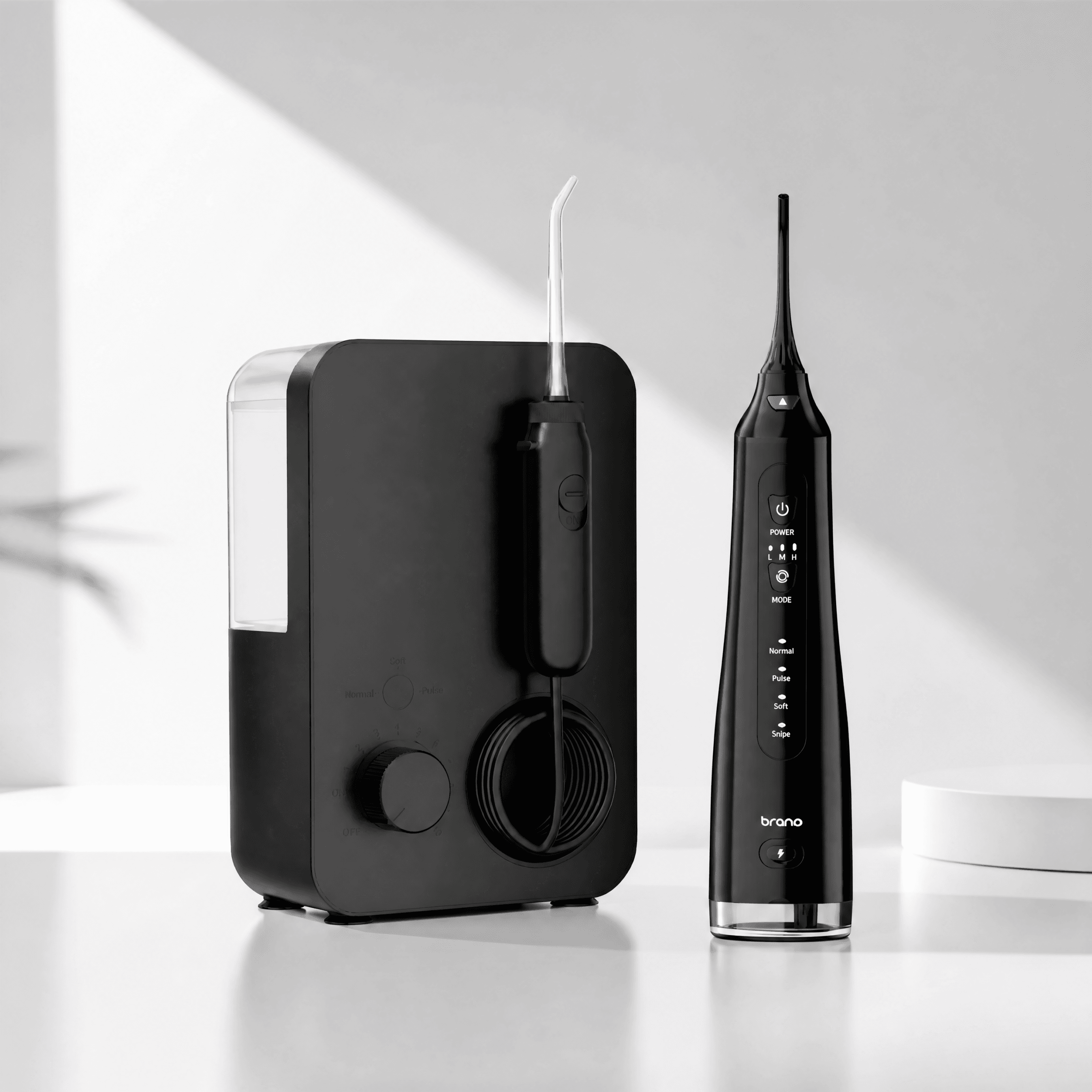
When Portable Makes Sense
Portable water flossers dominate e-commerce and travel retail channels. They’re impulse-buy friendly ($20–40 retail range), easy to ship, and appeal to younger consumers who value minimalism.
Markets where portable models sell best:
- East Asia (Japan, Korea, China): Small bathrooms are the norm. A compact device that sits on a narrow sink ledge is non-negotiable. USB-C charging is expected.
- Online DTC brands: Lighter shipping weight, simpler packaging, lower return risk. Most Amazon and Shopify oral care startups start with a portable model.
- Travel/commuter segment: Compact enough for a gym bag or carry-on.
What buyers need to check when sourcing portable models:
- Battery must survive 10–14 days of use on one charge (advertised "30 days" is often marketing fluff)
- The water tank should seal tightly — leakage during travel destroys reviews
- Motor noise under 65dB at max pressure is the acceptable ceiling
When Countertop Makes Sense
Countertop flossers are the "family device." They’re bought for households, not individuals, and typically retail at $50–80. The buying decision is driven by perceived durability and cleaning power.
Markets where countertop models dominate:
- Western Europe and North America: Larger bathrooms with dedicated counter space. Consumers expect a device that stays plugged in and gets used by multiple family members.
- Russia and Eastern Europe: Buyers prioritize build quality and longevity over portability. A countertop unit feels like a "real appliance," not a gadget.
- Dental clinics and professional channels: Countertop models are often used for in-clinic demonstrations and recommended to patients.
What buyers need to verify:
- The pump motor lifespan rating (look for 500+ hours of rated operation)
- Multiple pressure settings (5–10 modes is standard; anything less feels limited)
- Tip storage — countertop units should include onboard storage for 4–6 nozzles
- Hose length and connection durability (this is the #1 failure point in budget models)
The Hybrid Option: Cordless with a Base Station
There’s a third design gaining traction: a cordless model that charges on a countertop base station. It combines the portability of a handheld with the always-ready convenience of a countertop unit. If you’re targeting the premium tier ($60+), this is worth considering — it’s currently under-supplied relative to demand.
How to Match Design to Your Market
| Your Target Market | Recommended Design | Key Selling Point |
|---|---|---|
| Japan, Korea, Southeast Asia | Portable (compact) | USB-C charging, IPX7, under 200g |
| Western Europe, North America | Countertop | 10 pressure settings, 1L tank, family nozzle kit |
| Russia, Eastern Europe | Countertop (rugged build) | Long motor lifespan, simple controls, durable hose |
| E-commerce (Amazon, Shopee) | Portable or Hybrid | Strong unboxing experience, compact packaging |
| Dental professionals, B2B wholesale | Countertop | Clinical-grade pressure range, onboard tip storage |
One Thing Most Buyers Overlook
The tip ecosystem matters as much as the main unit. A water flosser that only ships with a standard jet tip limits your upsell potential. Look for manufacturers that can supply:
- Orthodontic tips (for braces users)
- Periodontal tips (for gum pocket cleaning)
- Tongue cleaner tips
- Multiple standard tips (different colors per family member)
A complete tip kit turns a one-time purchase into a recurring-consumables business.
Bottom Line
Portable water flossers fit brands selling to individuals through e-commerce, especially in Asia. Countertop models serve households and professional channels in Western markets. If you’re not sure which direction to take, start by defining your target market and retail price point — the design decision follows naturally.
Besman manufactures both portable and countertop water flossers with OEM/ODM customization available. Get in touch to discuss which model fits your market.