
MOQ, Lead Time & Pricing: How Oral Care OEM Quoting Actually Works
You’ve found a manufacturer, sent your product idea, and asked for a quote. What comes back often confuses buyers more than it clarifies: a per-unit price with no breakdown, an MOQ that seems arbitrary, and a lead time that later turns out to be optimistic.
Understanding how quoting actually works — what drives the number, why MOQ exists, and where lead time really goes — puts you in a much stronger negotiating position. It also helps you spot a quote that’s too good to be true before you wire a deposit.
Here’s the anatomy of an oral care OEM quote.
Why Unit Price Doesn’t Exist in Isolation
The single biggest misunderstanding in sourcing: buyers ask "what’s your price for an electric toothbrush?" as if there were one answer.
There isn’t. The unit price is a function of at least five variables — quantity, specification, tooling status, packaging, and customization depth. Change any one, and the number moves. A $6 unit and a $12 unit can be the exact same housing and motor, differing only in battery chemistry, waterproofing level, packaging, and order volume.manufacturing model fits your plan
When you request a quote, supply these five things and you’ll get an accurate number on the first pass:
- Target quantity (first order and annual estimate)
- Product type and key specs (sonic or rotary, IPX rating, battery type, pressure settings)
- Customization level (shell color, logo, new mold or existing tooling)
- Packaging requirement (plain box, retail gift box, custom insert, manual language)
- Destination market (affects certification and labeling)
A manufacturer who quotes without asking these is quoting a guess.
The Cost Stack: Where Your Unit Price Comes From
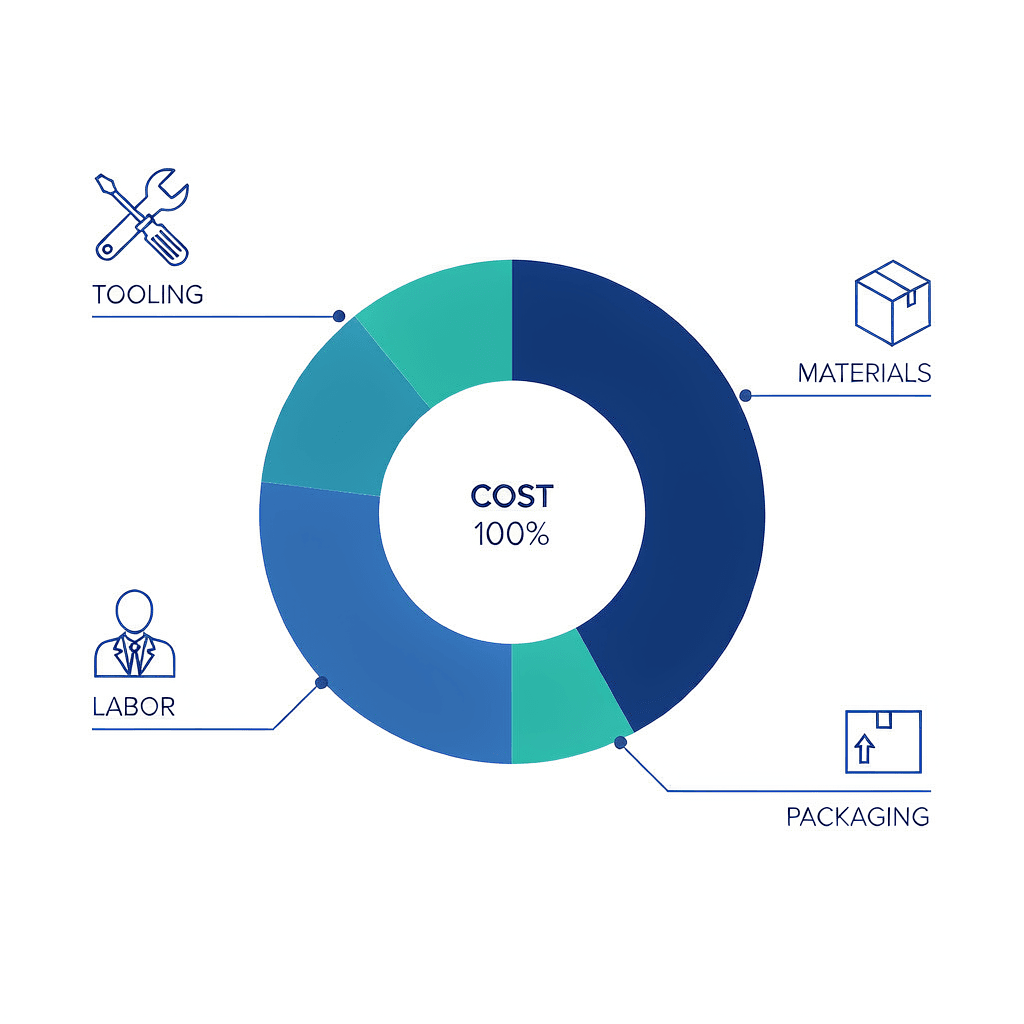
Every OEM quote is built from the same layers. Knowing them lets you see which parts are negotiable and which aren’t.
| Cost Layer | What It Covers | Notes |
|---|---|---|
| Tooling / NRE | Injection molds, fixtures, testing jigs | One-time; often amortized into unit price |
| BOM (materials) | Housing plastic, motor, PCB, battery, seals, bristles | Largest recurring cost; scales with volume |
| Labor & assembly | Line time, QC, packing labor | Varies by automation level |
| Packaging | Box, insert, manual, barcode, retail compliance | Frequently underestimated |
| Certification | Testing, reports, marks for your markets | Per market; sometimes shared |
| Logistics | Carton design, freight, battery documentation | Lithium products carry extra cost |
| Margin | Factory profit | Typically 8–20% for OEM work |
The two levers most buyers overlook are tooling amortization and packaging. A factory that spreads tooling cost across your first-year volume can look expensive per unit on a small order — while a factory that "waives" tooling may be recovering it in a higher unit price or in a long-term supply lock-in. Ask explicitly how tooling is charged.
MOQ: Why It Exists and How It’s Set
MOQ (Minimum Order Quantity) isn’t a sales tactic. It’s driven by physical production economics.
What drives MOQ:
- Injection molding setup — a mold run has a minimum viable batch before setup cost per part becomes absurd
- Component MOQs from sub-suppliers — the factory’s own vendors (motors, PCBs, batteries) have minimums too
- Assembly line efficiency — switching a line to a new SKU costs time whether you make 500 units or 5,000
- Material procurement — custom-colored plastic or custom-printed packaging often has its own minimum
Typical ranges in oral care manufacturing:
| Scenario | Typical MOQ Range |
|---|---|
| White-label, existing stock product | Lowest (sometimes a few hundred units) |
| ODM with custom color/logo on existing mold | Low to medium (often ~1,000 units) |
| ODM with custom packaging | Medium (custom print minimums apply) |
| OEM with new tooling |
| Highest (often several thousand units to justify mold cost) |
| Custom battery or new motor spec | Highest + longer lead time |
Two practical ways to lower effective MOQ:
- Mix SKUs in one order — often you can split an MOQ across color variants or two models, since the constraint is line setup rather than each SKU individually. Ask.
- Stage your order — commit to a total annual volume with scheduled releases, rather than one large upfront order. Factories will often accept a lower first release against a committed annual forecast.
Lead Time: Where the Weeks Actually Go
Lead time is not one block of time — it’s a sequence, and delays usually happen in the same few places.
| Stage | Typical Duration | What Can Go Wrong |
|---|---|---|
| Quotation & spec confirmation | 3–7 days | Vague specs cause repeated revisions |
| Sample development | 7–20 days | Custom colors or new features take longer |
| Sample approval & revisions | 5–15 days | Each revision round adds days |
| Tooling (if new mold) | 25–45 days | The single biggest variable |
| Certification testing | 2–8 weeks | Longer for EAC; depends on market |
| Mass production | 15–30 days | Material shortages, Chinese New Year shutdown |
| QC & packaging | 3–7 days | Rework if a batch fails inspection |
| Booking & freight | 7–14 days (sea) | Peak season congestion |
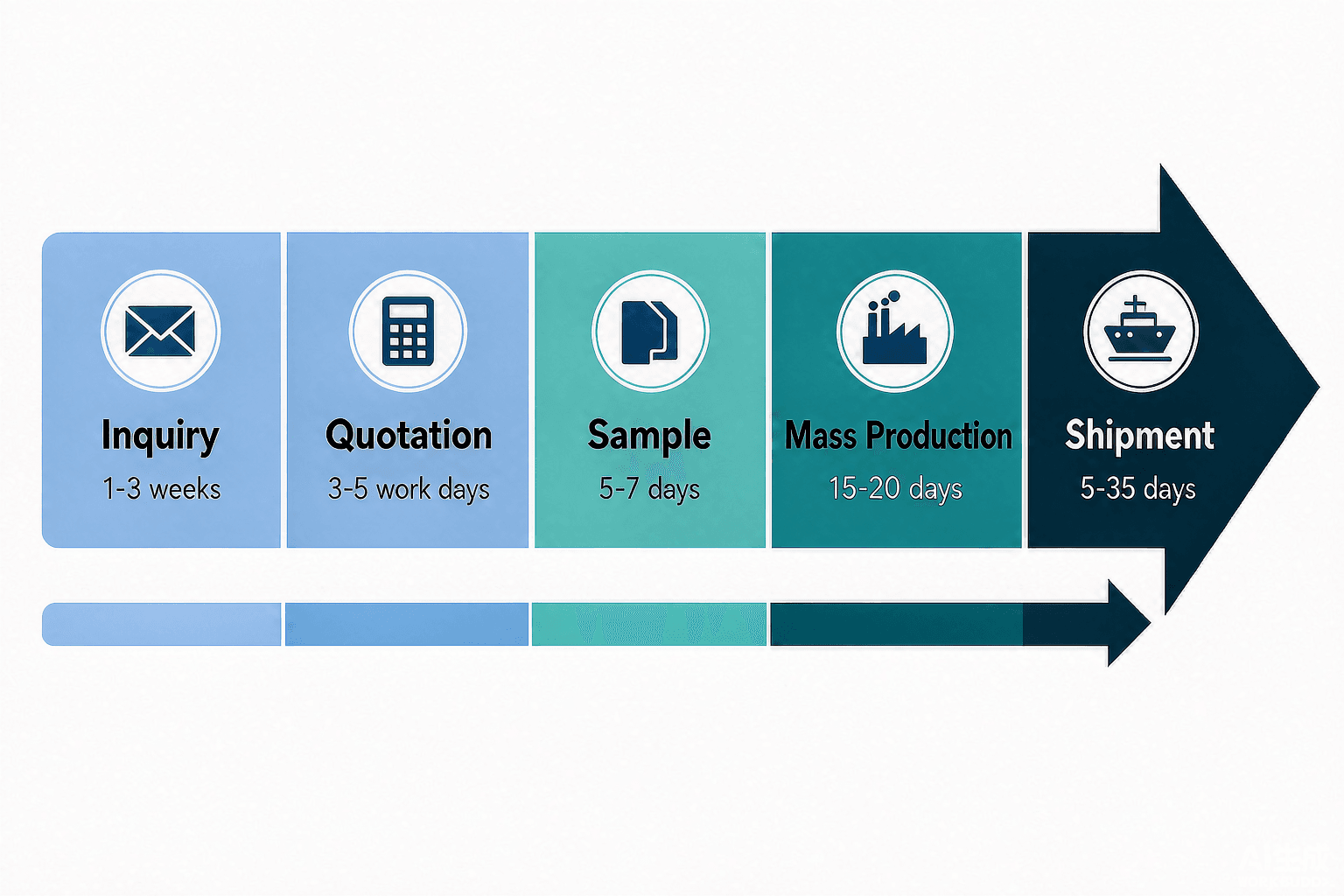
Realistic total from first inquiry to goods ready: roughly 8–12 weeks for an ODM product on existing tooling, and 16–24 weeks for a full OEM development with new tooling and certification.
Two scheduling traps worth naming:
- Chinese New Year — factories shut for 2–3 weeks and ramp slowly afterward. Orders placed in November–December often slip into March. Plan around it rather than discovering it.
- Certification sequencing — testing often can’t finish until production samples exist, so certification and production timelines interact. If you need EAC for Russia, add weeks.
Anatomy of a Quote: What a Good One Contains
A professional quotation should be a document, not a number in a chat message. Check that it includes:
- Exact model reference and configuration (not just "electric toothbrush")
- Unit price with currency and Incoterm (FOB, EXW, CIF — these differ by real money)
- Quantity price tiers (so you can see how price scales)
- Tooling / NRE charges, separately itemized
- Sampling fee, and whether it’s refundable against the order
- MOQ per SKU and per color
- Stated lead time in weeks, with the trigger point defined (from deposit? from sample approval?)
- Payment terms (typical: 30% deposit / 70% before shipment; be wary of 100% upfront)
- What’s included in the price (certification? packaging? carton?)
- Validity period (material prices move; a quote without an expiry is meaningless)
If any of these are missing, ask before comparing suppliers. Quotes that aren’t comparable on Incoterms and inclusions routinely mislead buyers by 10–20%.
How to Compare Quotes Without Getting Fooled
Two quotes can differ by 30% and both be honest — because they’re not quoting the same thing. Before you compare, normalize:
- Convert all to the same Incoterm (usually FOB is the fairest baseline)
- Add back tooling to see a true first-order cost
- Check battery and certification inclusions — these are the most common hidden differences
- Confirm the spec is identical — a cheaper motor or thinner housing explains most price gaps
- Ask what happens at 2× and 5× volume — the slope reveals how much is fixed cost vs. real material cost
Red flags in a quote:
- A price dramatically below every other supplier, with no explanation of what’s different
- Refusal to itemize tooling or to state an Incoterm
- No stated MOQ, then an MOQ appearing after you commit
- Lead time quoted in days rather than weeks for a custom product
- Pressure to pay a large deposit before any sample exists
The Bottom Line
MOQ, lead time, and price are not arbitrary numbers to be negotiated down — they’re the visible output of real production economics. The buyer who understands the cost stack negotiates on the right levers (volume, tooling terms, packaging, sequencing) instead of just pushing for a lower number that quietly degrades the product.
Before you place an order, get three things in writing: an itemized quote with Incoterm, a stated MOQ per SKU, and a lead time with its starting trigger. Everything else is a conversation.
Besman provides OEM, ODM, and white-label manufacturing for electric toothbrushes and water flossers, with transparent quoting, tooling terms, and certification support for EU, US, and EAEU markets. Send your spec for a detailed quotation.