
Water Flosser Pressure Ratings Explained: PSI, Pulsation & Flow Rate for OEM Buyers
Walk into any water flosser product page and you’ll see the same headline number: pressure, measured in PSI. 60 PSI. 100 PSI. 120 PSI. As if it were the whole story.
It isn’t. Three parameters together determine how a water flosser actually performs: pressure, pulsation frequency, and flow rate. A device advertising 120 PSI that delivers 200 ml/min of water performs completely differently from one delivering 120 PSI at 800 ml/min — yet both can print the same headline number.
If you’re specifying a water flosser for OEM manufacturing, here’s what each parameter does, how they interact, and what to put in your spec sheet.
How a Water Flosser Actually Works
A water flosser is a pump, a reservoir, and a nozzle. The engineering decisions happen in the pump.
Two pump architectures dominate:
Diaphragm pump — a flexible membrane oscillates to push water. Self-priming, handles low water levels, quieter, simpler sealing. Dominant in portable and mid-range units. Lower peak pressure ceiling.
Piston pump — a rigid piston in a cylinder pushes water. Higher achievable pressure, more consistent pressure under resistance, but noisier and more sensitive to air ingress. Found in higher-pressure countertop units.
Both are driven by a small DC motor, usually through a reduction gear or cam arrangement that converts rotation into the pulsation stroke.
The question to ask your factory: "Which pump architecture does this design use?" It tells you the realistic pressure ceiling, noise floor, and failure modes before you ever see a sample.
The Three Parameters That Define Performance
| Parameter | What It Means | Typical Range |
|---|---|---|
| Pressure (PSI) | Force of the water stream at the nozzle | 30 PSI (sensitive) – 120 PSI (max) |
| Pulsation frequency | Pulses per minute, creates the cleaning action | 1,200 – 1,800 pulses/min |
| Flow rate (ml/min) | Volume of water delivered per minute | 200 – 1,400 ml/min |
Why flow rate matters more than most buyers realize: the cleaning mechanism of a water flosser is a combination of pressure and volume. Pressure dislodges debris; flow carries it away. A high-pressure stream with very low flow produces a sharp jet that stings the gums but removes little. A high-flow stream at moderate pressure cleans effectively and feels comfortable.
This is the classic trap in cheap portable units: 100+ PSI advertised, but flow rate under 300 ml/min. The device feels aggressive and underperforms — and generates "hurts my gums but doesn’t clean" reviews.
Specify both numbers. Any manufacturer who can only tell you the PSI is either not testing the pump or hoping you won’t ask.
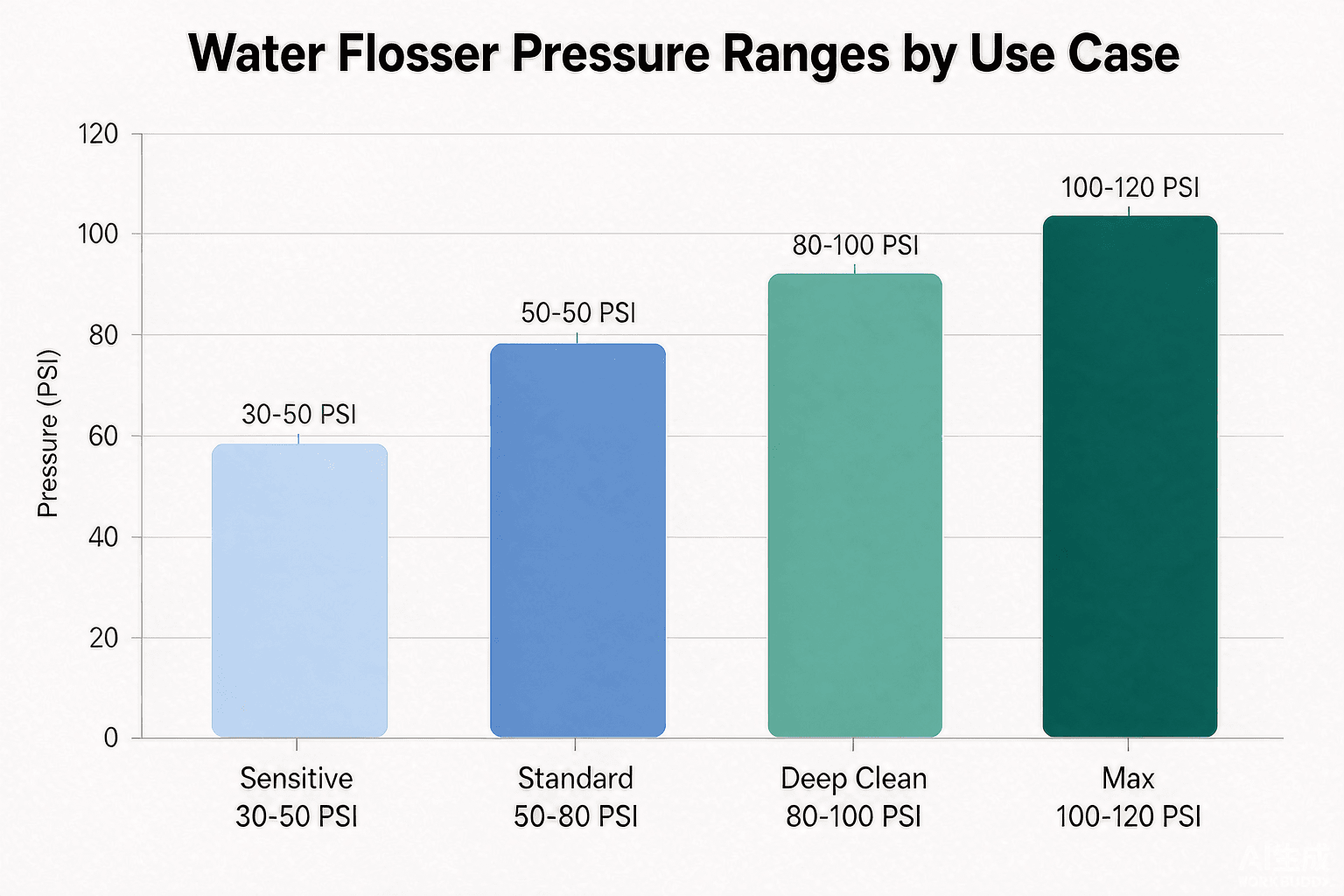
Pressure Ranges and What They Signal
| Range | Use Case | Notes |
|---|---|---|
| 30–50 PSI | Sensitive gums, first-time users, children’s units | Often the low setting of a multi-mode device |
| 50–80 PSI | Standard daily cleaning | The effective default for most adults |
| 80–100 PSI | Deep cleaning, orthodontic users | Requires good flow rate to be tolerable |
| 100–120 PSI | Maximum, "deep clean" mode | Only meaningful with adequate flow; often marketed more than used |
What buyers should know about mode counts: a device claiming "10 pressure modes" often varies only the low-to-mid range. Ask for the actual PSI at each mode, not just the count. A 10-mode device spanning 30–70 PSI is a sensitive-gum device; a 5-mode device spanning 40–110 PSI has a wider useful range.
Market positioning note: our portable vs countertop comparison covers how pressure ceilings differ between form factors — portables generally top out lower due to pump size and battery constraints.
Pulsation Frequency: The Cleaning Mechanism
The pulsation isn’t a side effect — it’s the mechanism. Intermittent pulses create micro-pressure waves that dislodge debris and stimulate gum tissue in a way a continuous stream does not.
Typical range: 1,200–1,800 pulses per minute. This is fairly consistent across manufacturers because it’s bounded by physics and comfort:
- Too slow — feels like a continuous dribble; cleaning effect drops
- Too fast — feels harsh; motor noise rises; some users find it uncomfortable
- Sweet spot — most clinical literature and product design converges around 1,200–1,600
Two things to verify:
- Is the pulsation frequency stated, or only "pulsating"? Marketing copy often uses "pulsating" as a feature word with no number behind it.
- Does the frequency hold under load? A pump that pulses at 1,400/min free-running may drop noticeably when the nozzle is pressed against a surface. Ask for the frequency at rated back-pressure, not just at open flow.
Tank Capacity: Do the Math Before You Specify
Tank size is a direct consequence of flow rate, and this is where buyers and end users most often end up disappointed.
The math: a typical cleaning session uses 20–40 seconds per quadrant, so roughly 40–90 seconds total for many users; thorough users go longer.
| Flow Rate | 60 Seconds of Use | Tank Needed |
|---|---|---|
| 300 ml/min | 300 ml | ~300 ml |
| 500 ml/min | 500 ml | ~500 ml |
| 800 ml/min | 800 ml | ~800 ml |
| 1,200 ml/min | 1,200 ml | ~1,200 ml |
The implication: if you spec a high flow rate (good cleaning) with a small tank (compact design), the user will have to refill mid-session. That single experience detail generates a large share of negative reviews on compact portables.
Two ways to solve it — and you must pick one deliberately:
- Match the tank to the flow (larger tank, less compact)
- Add a pause/resume function so the user can refill without restarting the session
Specifying 800 ml/min flow into a 150 ml tank without a refill-friendly design is a specification error, not a marketing choice.
Noise, Vibration and Sealing
Noise comes primarily from the pump motor and the water flow itself. Typical practical ranges:
| Class | Noise at 30cm | Notes |
|---|---|---|
| Quiet | 55–65 dB | Achievable with diaphragm pumps and damped mounts |
| Typical | 65–75 dB | Most mid-market units |
| Loud | > 75 dB | Common complaint category in reviews |
Ask: "Measured at what distance, at what pressure setting?" — the same qualifier that applies to toothbrush motors.
Sealing is where water flossers fail more than toothbrushes, because they hold water under pressure. Four failure points to ask about:
- Nozzle-to-handle interface — must seal at maximum pressure; this is the most common leak point
- Tank-to-body seal — particularly critical on portable units carried in bags
- Water inlet and valve — cheap valves leak or stick
- Charging port — wireless charging eliminates the weakest point entirely
Our IPX7 explainer covers how these should be tested in production. For a water flosser specifically, ask whether immersion testing is run with the tank filled.
Pump Life and Reliability Testing
The pump is the wear component. Its life rating determines your warranty exposure.
Ask for:
- Rated pump life in hours of operation — target 300+ hours minimum; premium units should aim higher. Translate this into years for your users (a 200-second daily session at 300 hours is roughly 9 years of use — so pump life is usually not the limiting factor if the rating is honest).
- Endurance test protocol — continuous cycling with pressure measurement to detect degradation. A pump whose pressure drops 30% over its test is a warranty problem waiting to happen.
- Post-drop function test — drops damage housings and sometimes dislodge internal tubing.
- Dry-run protection — does the device survive being run with an empty tank? Many users do this. If it burns the pump, specify protection.
What to Put in Your RFQ
Send these to your factory:
- "What’s the maximum and minimum pressure in PSI at each mode setting?"
- "What is the flow rate in ml/min, and at what pressure is it measured?"
- "What is the pulsation frequency, and does it hold under back-pressure?"
- "Which pump architecture — diaphragm or piston? Is the pump made in-house or sourced?"
- "What noise level do you specify, measured at what distance and pressure?"
- "What pressure test do you run on the nozzle-to-handle seal?"
- "What is the rated pump life, and what endurance protocol do you run?"
- "Does the design include dry-run protection?"
- "Can you provide a pressure/flow curve across all mode settings?"
Question 9 is the tell. A manufacturer with a real pump test bench can produce this chart in an afternoon. A trading company will send you a spec sheet with numbers copied from a competitor’s product page.
The Bottom Line
PSI is the easiest number to print and the least sufficient number to specify. Water flosser performance is a product of pressure × flow for cleaning effect, pulsation frequency for the mechanism, and tank sizing for whether any of it is actually usable in a single session.
Specify all four, ask for the curves behind them, and check that your tank capacity matches your flow rate before you commit to tooling. These are cheap decisions to make at the drawing stage and expensive ones to discover in customer reviews.
And when you’re thinking about repeat revenue, remember that the nozzle ecosystem is the consumable side of the same product — see our consumables guide for how tip variety supports reorder behavior. Battery chemistry interacts with all of this too, since pump load drives current draw — the battery comparison covers that trade-off.
Besman manufactures portable and countertop water flossers for OEM and ODM projects, with in-house assembly and motor performance testing including load curves, noise, and endurance verification. Send us your spec to discuss pressure, flow and pump configuration for your market.