
Brush Heads & Replacement Tips: How to Build a Consumables Business Around Your Oral Care Brand
Most oral care brands spend 95% of their attention on the device — the motor, the design, the launch campaign — and almost none on the part that keeps customers coming back every three months.
That’s a mistake, and an expensive one.
A toothbrush handle is bought once. Brush heads are bought four times a year, forever. A water flosser is bought once; nozzles are replaced every three to six months. The device is your acquisition product. The consumable is your business.
Here’s how to design, source, and package consumables so they actually generate recurring revenue instead of becoming an afterthought.
The Economics: Why Consumables Decide Your Long-Term Margin
Consider a typical product line:
| Item | Retail Price | Purchase Frequency | Annual Revenue per Customer |
|---|---|---|---|
| Electric toothbrush handle | $40–80 | Once | $40–80 |
| Replacement brush heads (4-pack) | $15–25 | 2–4 times per year | $30–100 |
| Water flosser unit | $50–80 | Once | $50–80 |
| Replacement nozzles (4-pack) | $10–18 | 2–3 times per year | $20–54 |
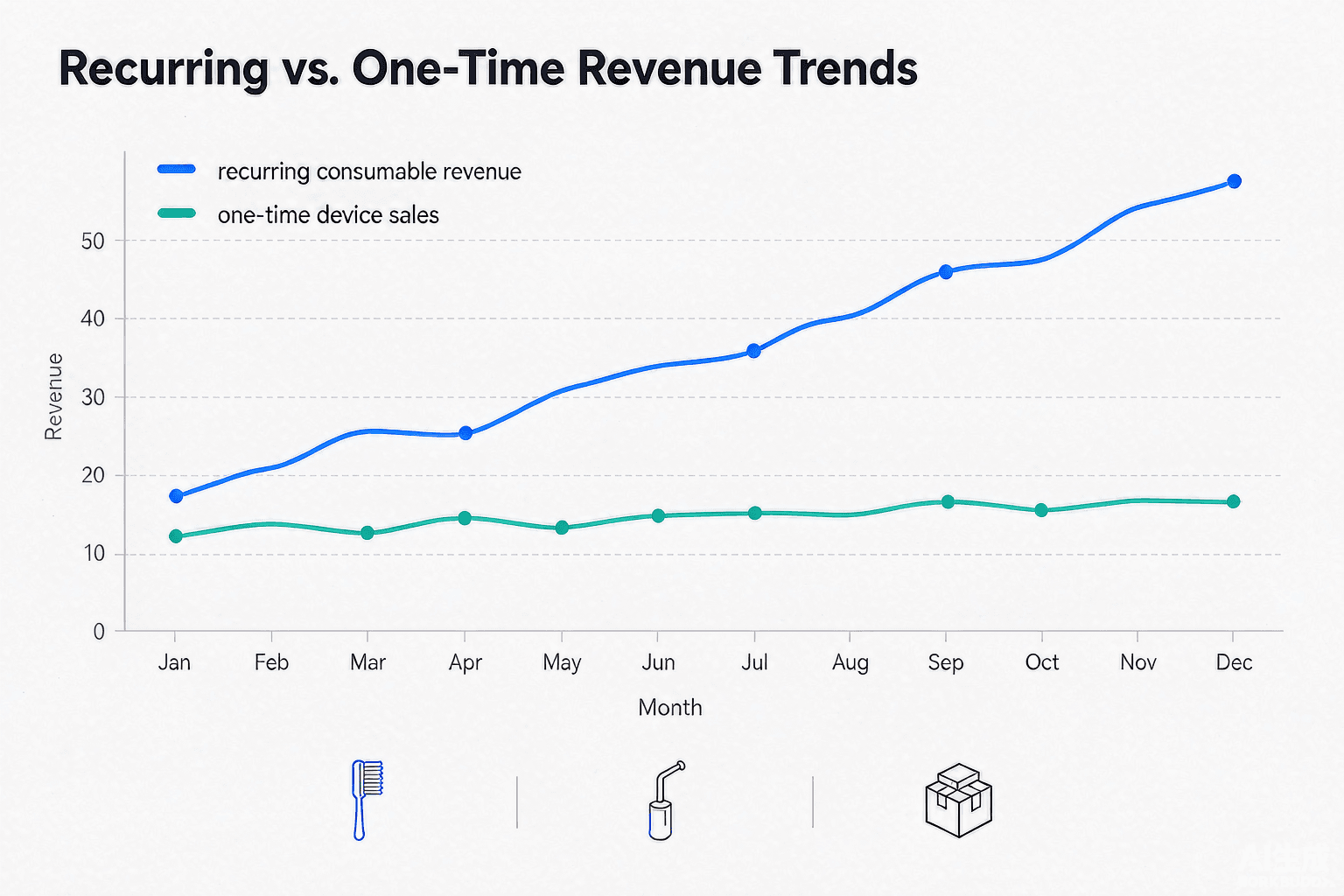
Within twelve to eighteen months, the consumable line out-earns the original device sale. And unlike device sales, consumable revenue doesn’t require re-acquiring the customer.
Two implications for your sourcing decision:
- Consumables have better margins — smaller, lighter, cheaper to ship, no battery or certification complications.
- Ecosystem lock-in determines whether you capture that revenue at all. If a customer can buy a compatible head from a third party at half the price, they will.
Design Decision #1: Brush Head Compatibility
This is the most commercially significant engineering decision in your entire product line — and it’s usually made by accident.
Three strategies:
Proprietary interface. The head only fits your handle. Maximum lock-in, maximum consumable revenue. Requires you to control tooling and to keep replacement heads consistently in stock — an out-of-stock head is a lost customer forever.
Open/standard interface. Your handle accepts widely available heads (e.g., a common Philips or Oral-B compatible mount). Easier for customers, but you compete with $2 generic heads and your consumable margin evaporates.
Hybrid. Proprietary mechanical interface with a designed feature advantage — a distinctive cleaning action, a specific bristle pattern, or a sensor handshake — so cheap copies can’t fully substitute.
What to specify: decide this before tooling. Once you’ve committed to a mold, changing the interface means new tooling on both the handle and the heads. Ask your manufacturer explicitly: "What interface does this design use, and can third parties make compatible heads for it?"
For most B2B brands launching a first product, the hybrid approach is the right default: some lock-in, without the stockout risk of a fully proprietary system.
Design Decision #2: Bristle Material and Quality
Bristle quality is where cheap heads become obvious to the customer within a few weeks — fraying, splaying, or feeling scratchy.
| Bristle Type | Characteristics | Positioning |
|---|---|---|
| DuPont Tynex / nylon | Industry standard; consistent diameter, good end-rounding | Mid to premium |
| Pedex (Germany) | Premium nylon, excellent softness consistency | Premium |
| Generic PBT nylon | Cheaper, variable quality, harder to guarantee end-rounding | Budget |
| Charcoal-infused | Marketing-friendly, marginal functional benefit | Value-added positioning |
| Micro-fine / ultra-soft | Very fine filaments for sensitive gums | Sensitive-gum segment |
The quality parameter that matters most is end-rounding. Bristle tips must be polished to a rounded shape; sharp-cut tips damage gums and are a genuine safety concern — and easier for competitors and reviewers to detect than advertised bristle brands.
Ask for: the bristle supplier name, filament diameter (typically 0.10–0.15mm for adult heads), and the end-rounding specification. Request a magnified photo of the bristle tips from a production batch — a real manufacturer can provide this.
Design Decision #3: Functional Features That Justify Repurchase
A plain round head competes only on price. Feature differentiation is what supports a higher retail price and reduces churn.
Worth including:
- Wear indicator bristles — color fades over roughly three months, prompting replacement. Simple, cheap, and the single most effective repurchase trigger.
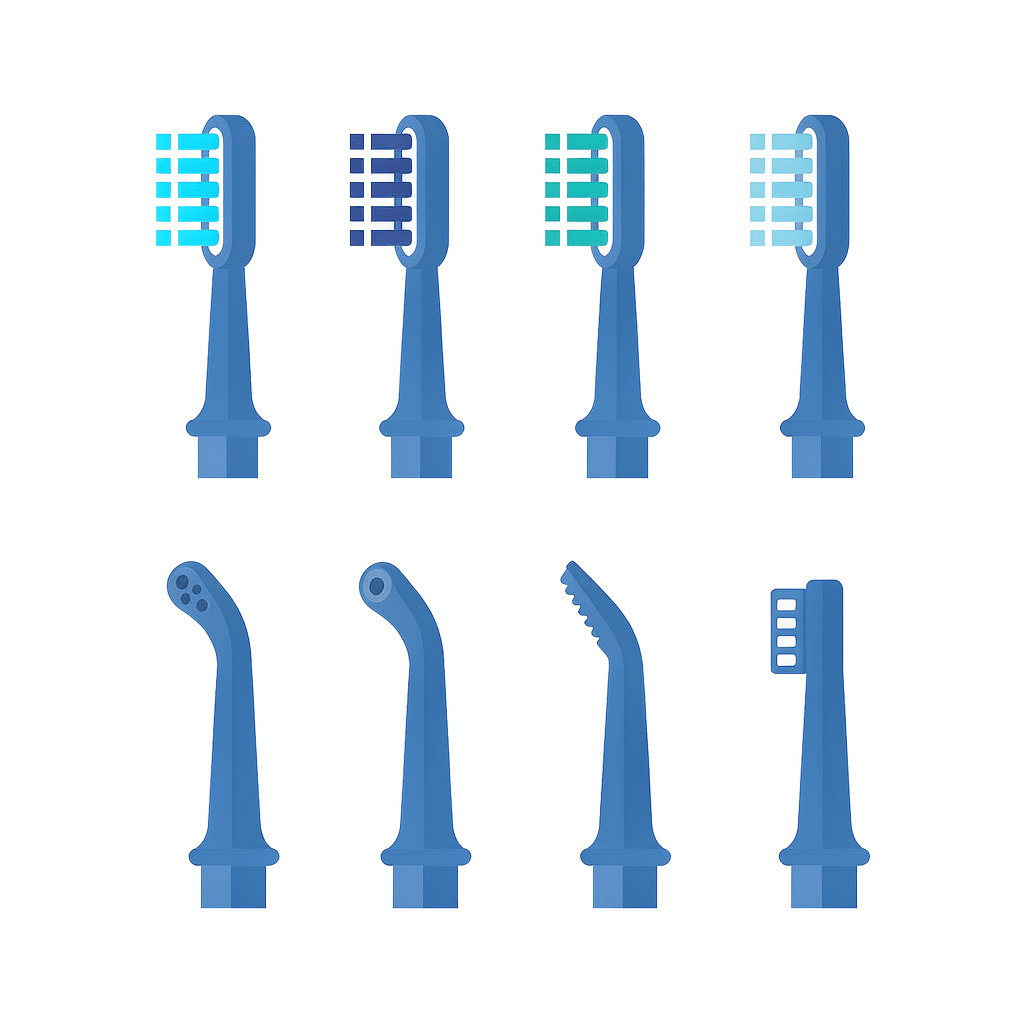
- Distinct head variants — standard, sensitive/soft, whitening cup, orthodontic. Gives customers a reason to reorder a specific SKU rather than a generic one.
- Tongue cleaner on reverse — low cost, adds a feature line to the packaging.
- Color coding — different color rings let family members distinguish heads. Drives multi-unit purchases.
Also worth deciding: whether heads are cross-compatible across your own handle lineup. A single head fitting three handle models simplifies your inventory and reduces stockout risk substantially.
Water Flosser Nozzles: The Same Logic, Different Design
Nozzles are the consumable for your flosser line, and the tip ecosystem is often an entirely untapped revenue stream.
| Nozzle Type | Function | Target Segment |
|---|---|---|
| Standard jet | General cleaning | Default included tip |
| Orthodontic | Angled for braces and brackets | High-demand, underserved segment |
| Periodontal / pocket | Soft flow for gum pockets and sensitivity | Clinical recommendation driver |
| Tongue cleaner | Tongue surface cleaning | Value-add |
| Multi-color set | Family sharing, no mix-ups | Drives multi-pack purchases |
Two sourcing points to verify:
- Chamber compatibility — the tip mount dimension must hold a seal at full pressure. Leaks at the tip connection are a leading complaint in reviews. Ask what test they run on the tip-to-handle interface under maximum rated pressure.
- Nozzle lifespan claim — instructions typically recommend replacement every three to six months. If your nozzle is designed for a longer interval, say so; it becomes a genuine selling point against competitors.
A complete tip kit shipped with the device also raises perceived value at almost no incremental cost — and every extra tip the customer uses is one more they’ll need to reorder.
Packaging: Where Consumables Succeed or Fail
Consumable packaging has a different job from device packaging. Devices sell on shelf; consumables sell on convenience at the moment of repurchase.
Retail packs:
- 2-pack / 4-pack configurations — the standard for refill purchases
- Hang tab for retail pegs
- Clear visual compatibility callout — which handle models it fits, in every local language
- Wear-indicator explanation printed on the back (this literally drives the next purchase)
- Barcode and compliance labeling for each target market
Subscription / DTC mailers:
- Flat, letterbox-friendly design to avoid failed deliveries
- Branded but minimal — the unboxing moment is at first delivery; repeat shipments should be efficient, not extravagant
- Insert with usage guidance — and the next reorder prompt
Packaging costs are a bigger share of a consumable’s price than of a device’s. Model the packaging cost as a percentage of retail before committing to a premium box, and check MOQ for custom-printed packaging separately from the head itself.
MOQ and Tooling: Why Consumables Are Easier Than Devices
Good news for smaller brands: consumables generally have lower tooling cost and lower MOQ than complete devices.
| Item | Typical Tooling Complexity | Typical MOQ Profile |
|---|---|---|
| Brush head (existing interface) | Low — small mold, few parts | Low; often flexible |
| Brush head (new proprietary interface) | Medium — needs handle mold match | Medium to high |
| Flosser nozzles (standard) | Very low | Low |
| Custom-printed retail packaging | None (print setup only) | Set by print minimums, often the binding constraint |
Two practical notes:
- The binding constraint is often packaging, not the product. A factory may accept a low MOQ on heads but require several thousand units for a custom-printed box. Ask separately.
- Bundling works in your favor. Ordering heads and nozzles together, or mixing head variants within one production run, often lowers your effective MOQ or improves your per-unit price.
If you’re weighing how consumables fit into a broader sourcing plan — tooling amortization, staged orders, and volume tiers — the mechanics are the same as for devices; see our guide to MOQ, lead time and pricing.
Supporting a Subscription Model
If you plan to sell consumables on subscription, your sourcing has to support it. Requirements to build in from the start:
- Consistent stock availability — the #1 cause of subscription churn is a missed shipment
- Long shelf stability — bristles and packaging should hold up through warehouse storage
- Consistent packaging dimensions — mailers are designed around a fixed size; a packaging change breaks your fulfillment setup
- Batch traceability — if a batch of heads has a defect, you need to identify affected subscribers
- Predictable lead time — subscription inventory planning depends on it
Also worth noting: consumables escape most of the compliance complexity that device manufacturing carries. No battery transport rules, no wireless certification. The device determines your certification burden and your battery decisions; the consumable side is comparatively simple — which is another reason it deserves more of your attention, not less.
What to Ask Your Manufacturer
Send these with your consumable RFQ:
- "What interface does the brush head use, and can third parties produce compatible heads?"
- "Which bristle supplier and filament diameter do you use? Can you provide an end-rounding spec and magnified photo?"
- "Do you offer wear-indicator bristles, and what’s the fade duration?"
- "What head variants can you produce — standard, soft, whitening, orthodontic?"
- "For flosser nozzles, what pressure test do you run on the tip-to-handle seal?"
- "What’s the MOQ for heads alone, and separately for custom-printed packaging?"
- "Can you bundle brush heads and flosser nozzles in one production order?"
- "What’s your lead time for repeat consumable orders?" — repeat orders should be faster than the first; confirm this.
The Bottom Line
The device gets your customer. The consumable keeps them — and pays for the business. If you’re launching an oral care brand and treating replacement heads as an afterthought, you’re building a product instead of a company.
Decide the interface before tooling, specify bristle quality rather than assuming it, build in a wear indicator so repurchase happens on schedule, and package the refill pack for the moment of repurchase rather than the moment of sale.
Besman manufactures electric toothbrushes and water flossers together with their replacement brush heads and flosser nozzles, supporting proprietary or standard interfaces, multiple head variants, and retail or subscription packaging. Contact us to discuss your consumable program.