
How to Audit an Electric Toothbrush Factory: 12 Checks Before You Pay a Deposit
Most sourcing disasters don’t happen because the buyer chose a bad supplier. They happen because the buyer never actually verified the supplier — they verified a price, a WhatsApp conversation, and a business license photo.
A deposit is the point of no return. Before that wire transfer, you have all the leverage in the world to ask questions. After it, you have a project.
Here are the twelve checks that separate a real manufacturing partner from a trading company with a nice catalogue.
First: Know Who You’re Actually Talking To
Before the checklist, confirm the entity type. Three possibilities:
- Direct manufacturer — owns the factory, the molds, the assembly line
- Trading company — sources from factories, adds margin, controls little
- Factory-affiliated trading arm — real manufacturer selling through a separate commercial entity (common and usually fine)
None of these is automatically bad. A competent trading company can be an excellent partner for small buyers, and a bad factory is worse than a good trader. But you should know which one you’re dealing with, because it determines who controls your timeline, your quality, and your tooling.
How to tell: ask for the factory’s business license , then ask for a video call from the production floor — not the showroom. Location, scale, and equipment will reveal the truth faster than any document.
The 12 Checks
1. Business license and legal scope
Request the business license and confirm: is it a manufacturing entity , or is it trading? Check the registered capital and incorporation date — a company registered eight months ago with ¥1M capital is not a factory with a decade of tooling.
Verify via China’s National Enterprise Credit Information Publicity System or a service like Qichacha. Registered scope is public information; there’s no reason for a supplier to withhold it.
2. Certifications matched to the actual product
Factories love to show certificates. Your job is to check whether those certificates cover the product you’re buying, in the configuration you’re buying it in.
Match the model number and product photos inside the test report against the unit you’re being quoted. The most common trick in the industry: presenting a CE report for a premium model while quoting you a different, cheaper one.
For oral care devices, look for CE (with the applicable directives), RoHS, FCC, and — if Russia is in your plans — EAC. For lithium products, UN38.3 is non-negotiable. Our certification guide walks through exactly what each market requires.
3. Production line and assembly capability
Ask for a live video walk-through (not an edited promo video). Look for:
- An actual assembly line with operators at stations
- Work-in-progress inventory, not an empty floor
- Organized material storage with labeled bins
- Cleanliness and lighting quality
An empty factory "between orders" on the day you call is a warning. A factory that can’t do a live call at all is a bigger one.
4. SMT capability and PCB sourcing
Electric toothbrushes and water flossers use control PCBs. Ask whether the factory runs in-house SMT (surface-mount technology) or outsources it.
In-house SMT means better control of quality, faster iteration on firmware and component changes, and less finger-pointing when something fails.
Outsourced isn’t fatal — plenty of good factories do it — but it adds a link in the quality chain and usually extends lead time on revisions. Ask which it is, and ask to see the board line if they claim in-house.
5. In-house laboratory and QC equipment
This is one of the strongest signals of a real manufacturer. Ask what test equipment they own. For oral care devices, a credible factory should have:
- Waterproof/IP testing rigs (immersion tank, IPX spray setup)
- Motor performance test bench (RPM, torque, current draw)
- Battery charge/discharge cycle testing
- Aging/endurance test stations
- Environmental chamber (temperature/humidity) — better factories
- Salt spray or material durability testing — better factories
A factory that owns its test equipment can catch problems before shipment. A factory that sends everything to a third-party lab only during certification has no production-level quality control.
6. Motor testing and consistency
Ask for the motor test protocol and a recent report. The key question isn’t "does the motor work" — it’s how consistent is it batch to batch.
Look for: rated RPM tolerance (±5% is good, ±15% is loose), noise level at max speed (under 65dB is a reasonable target for sonic units), and whether they test 100% of units or sample. Some factories test every unit at the end of line; that’s the answer you want.
7. Waterproof testing on every batch
If your product claims IPX7, ask: "Do you run immersion tests on every production batch, or only during development?"
The correct answer is batch sampling at minimum. The best answer is batch sampling plus functional re-verification after immersion. Chapter and verse on how this should work is in our IPX7 explainer — use it as your reference when you ask.
8. Capacity and scheduling honesty
Ask three numbers: monthly output capacity, current capacity utilization, and the number of active clients.
A factory running at 95% utilization cannot fit your order in the timeline they quoted you. A factory with five clients and 500,000 units of monthly capacity is either lying about capacity or in trouble. Either way, you want the middle: busy but not saturated.
Also ask about Chinese New Year planning — it derails more shipments than any other single factor.
9. Upstream supply chain stability
The factory’s own vendors determine your consistency. Ask about their sources for motors, cells, and plastics, and whether they hold safety stock.
Battery cells are the most volatile component — lithium cell prices and availability swing, and a factory that buys cells on a weekly spot basis is exposed. Factories with long-term cell supply agreements are more stable partners. (The chemistry decision itself is covered in our battery comparison.)
10. Packaging, labeling, and carton quality
Packaging is where cheap factories quietly cut corners. Ask to see:
- A real retail box sample with inserts (not a rendering)
- Their box drop test standard
- Carton configuration and stacking strength
- Whether they handle retail labeling requirements (barcodes, compliance marks, warning text in target-market languages)
Requesting a finished, packed sample shipped to you is worth the courier cost every time.
11. Documentation and traceability
Ask: "If I have a defect in month six, how do you trace it back?"
A real factory has batch records linking production runs to material lots. A trading company will say "we’ll take care of it" with no mechanism behind it. Traceability is also a requirement for many retailer and regulatory audits — including FDA-related documentation if you sell in the US.
12. Communication responsiveness and engineering depth
Ask two technical questions and see who answers. If every query gets routed back to a salesperson reading from a spec sheet, you’re not talking to the factory’s technical team.
The single best test: ask about a change to the design — a different battery, a new feature, a tighter tolerance. A manufacturer with engineering depth can tell you immediately what’s feasible and at what cost. A trading company will say "I’ll check with the factory" for everything, forever.
How to Audit Without Visiting China
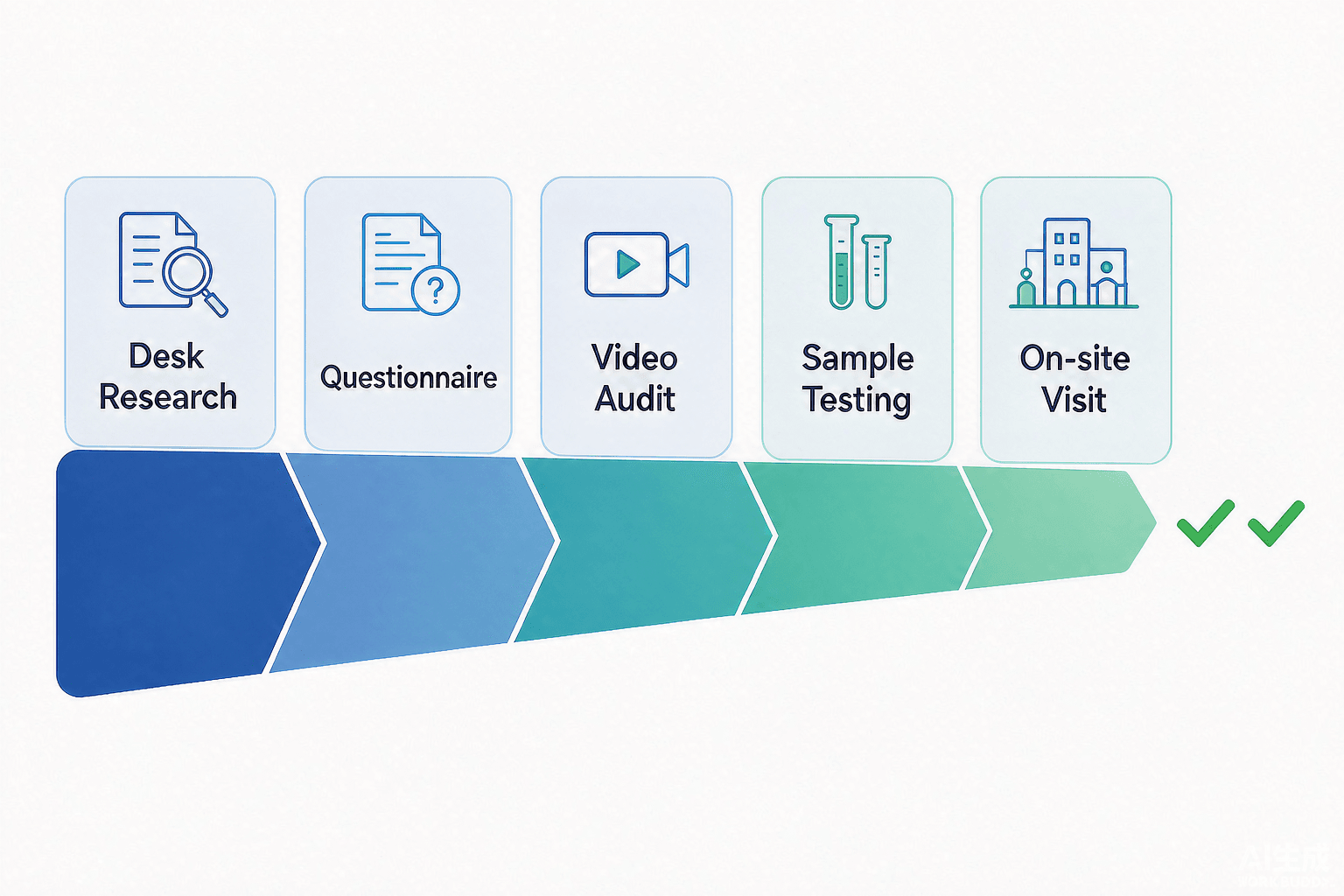
You don’t need to fly to Shenzhen. A remote audit gets you 80% of the answer:
| Step | What You Do | What It Reveals |
|---|---|---|
| 1. Desk research | Business license lookup, company age, registered scope | Whether they’re a real manufacturer |
| 2. Written questionnaire | Send the 12 questions above in writing, request documents | Response quality and documentation depth |
| 3. Live video audit | Unannounced or short-notice video walk-through of the floor | Reality vs. claims |
| 4. Sample testing | Order a sample, test it yourself, and send it to a third-party lab if needed | Actual product quality, not stated quality |
| 5. On-site visit (optional) | Hire a third-party inspection firm for a formal audit report | Independent verification for large orders |
For orders above roughly $50K, a third-party inspection (typically a few hundred dollars for a man-day) is cheap insurance.
Red Flags That Should Stop You
- Refuses a live video call or can only produce an edited promo video
- Cannot provide a certificate matching the quoted model
- Quotes a lead time in days for a custom product
- Demands full payment upfront, or a large deposit before any sample
- Answers technical questions vaguely and repeatedly defers
- Business license shows a trading scope and they deny being a trader
- Price dramatically below all other quotes with no explanation of spec differences
One red flag might be a misunderstanding. Three together is a pattern.
The Bottom Line
Auditing a factory isn’t about distrust — it’s about eliminating the scenarios that cost you a product launch. Every one of these twelve checks is answerable in a single afternoon by a competent manufacturer. The suppliers who struggle to answer them are telling you something important.
Run the checks before the deposit. After the deposit, your options narrow considerably.
Besman manufactures electric toothbrushes and water flossers with in-house tooling, assembly, and testing — including batch-level IPX7 verification and motor performance testing. We welcome video audits and third-party inspection. Request our factory documentation or arrange a live walk-through.