
Your order passed inspection. The cartons are sealed. The container booking is confirmed. And then the freight forwarder calls: "Your shipment is on hold — where’s the UN38.3 report, and why is there no lithium battery mark on the cartons?"
Welcome to the least glamorous part of sourcing oral care devices: getting battery-powered products legally from the factory to your warehouse. Battery shipping rules trip up even experienced importers, because the requirements live in a different regulatory world than product compliance — and the penalties for getting them wrong range from refused shipments to blacklisted forwarders.
This guide covers what B2B buyers of electric toothbrushes and water flossers actually need to know: the testing, the classifications, the labels, and the air-vs-sea decision.
First: UN38.3 Is a Transport Test, Not a Product Certificate
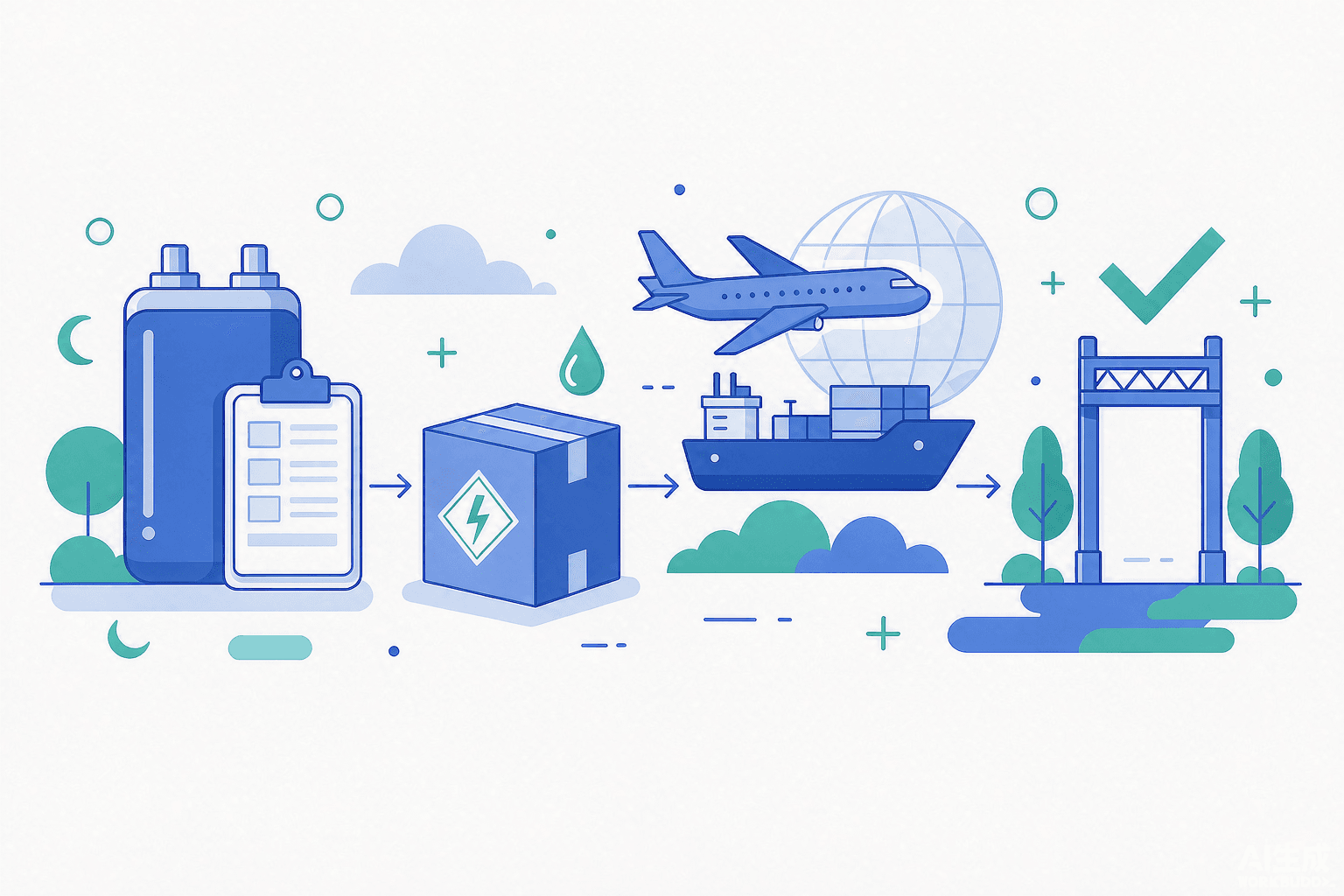
Buyers often lump UN38.3 in with CE or FCC. It isn’t the same category. UN38.3 comes from the UN Manual of Tests and Criteria and exists purely to prove a battery can survive transport — altitude, thermal cycling, vibration, shock, short circuit, and more (tests T.1 through T.8).
Three things matter for buyers:
- The report is tied to the specific battery model and cell manufacturer. If your device’s battery changes mid-project, the old report doesn’t cover the new cell — retest is required. Lock the battery early (our lithium vs. Ni-MH comparison explains why most modern devices go lithium)
- Always request the UN38.3 Test Summary — since 2019, regulations require manufacturers to provide this document on request. It’s a standardized format, and any serious factory hands it over without being asked twice
- UN38.3 is the entry ticket, not the whole ticket — packaging and marking rules apply on top of it
For how UN38.3 fits into the wider compliance picture, see our oral care certifications guide.
Know Your UN Number: 3480 vs. 3481
Lithium-ion shipments are classified under two UN numbers:
| UN 3480 | UN 3481 | |
|---|---|---|
| What it covers | Batteries shipped alone | Batteries packed with or contained in equipment |
| Your device? | Spare battery shipments | Finished toothbrushes & flossers |
| Air packing instruction | PI 965 | PI 966 (packed with) / PI 967 (contained in) |
| Restrictions | Strictest — cargo aircraft only, state of charge limits | Moderate — depends on battery size |
The good news for oral care buyers: a finished electric toothbrush ships as UN 3481, contained in equipment (PI 967) — the least restrictive common category, because the small batteries in these devices (typically well under 100 Wh) fall under the lighter sections of the rules.
The catch: if you also import spare batteries or replaceable battery packs for your SKUs, those ship as UN 3480 — and that’s where the strictest rules live, including the requirement that batteries be at no more than 30% state of charge for air transport and marked cargo-aircraft-only.
Labels and Markings: What Goes on the Carton
A compliant carton of battery-containing devices needs:
- The lithium battery mark — the hatched-edged label with the battery symbol and UN number (UN 3481), plus a phone number for additional information
- Class 9 lithium battery label when required for the packing section in use
- Correct outer packaging strength — batteries contained in equipment must be protected from damage, with the device secured against movement inside the box
- No mixed confusion — cartons containing devices vs. cartons containing spare batteries follow different rule sets and must be marked accordingly
Under-labeled cartons get rejected at the forwarder’s warehouse — which is annoying. Over-looked paperwork at the airline’s acceptance desk — which can mean missing your vessel or flight and rebooking at spot rates.
Air vs. Sea: The Practical Decision
| Air freight | Sea freight | |
|---|---|---|
| Regulatory burden | Highest — IATA dangerous goods rules, DG declaration, trained forwarder mandatory | Lower — IMDG rules are comparatively lighter for contained-in-equipment |
| Cost | Significantly higher per kg | Standard container economics |
| Speed | Days | Weeks |
| Best for | Urgent top-ups, launch stock, samples of finished devices | Main replenishment orders |
Practical patterns we see work well:
- Launch by air, replenish by sea. Get initial stock moving fast, then switch to containers once sales velocity is known
- Sea freight is the default for finished devices — for UN 3481 contained-in-equipment shipments, ocean is both cheaper and administratively simpler
- Whatever you do, use a forwarder with dangerous goods capability. A general forwarder who "accepts anything" is a liability with battery cargo — DG-trained forwarders exist precisely because this paperwork has zero tolerance for improvisation
The Buyer’s Shipping Checklist
Before your next battery-powered order ships:
- ✅ UN38.3 Test Summary received — and it matches the exact battery model in your device
- ✅ Battery spec locked — no cell substitutions after testing (this is also a contract point, not just a shipping point)
- ✅ Correct UN number confirmed — 3481 for finished devices; 3480 if any standalone batteries are in the same order
- ✅ Carton marks applied — lithium battery mark with UN number and contact info
- ✅ DG-trained forwarder engaged — ask directly if they handle Class 9 lithium battery cargo
- ✅ Documents in the shipment file — DG declaration where required, plus your standard commercial invoice and packing list
- ✅ Destination-market extras planned — some markets add their own requirements on top (for Russia and the EAEU, see our market entry guide)
Five Mistakes That Get Shipments Rejected
- Assuming product certifications cover transport. CE on the device says nothing about the carton’s lithium battery mark
- Switching battery suppliers after testing — new cell model means the UN38.3 report no longer applies
- Using a non-DG forwarder who discovers the problem at check-in, after your vessel booking
- Marking only the master carton — every relevant outer packaging needs compliant marks, not just the pallet wrap
- Treating labels as the factory’s problem alone — as the shipper of record, buyers share responsibility. Put marking requirements in writing in the purchase contract
A Note on Ni-MH Devices
All of the above applies to lithium-ion. Devices with Ni-MH batteries are not classified as dangerous goods in the same way and travel under normal cargo rules — one more factor in the lithium vs. Ni-MH decision, alongside energy density and cycle life. The logistics savings rarely outweigh the performance gap, but for very low-cost markets it’s a real input to the calculation.
The Bottom Line
Battery shipping compliance is not hard — it’s just unforgiving. The formula is short: correct battery testing tied to the exact cell, correct UN classification, correct carton marks, and a forwarder who knows what all three mean. Do those four things and your containers move; skip one and your stock sits in a warehouse in Shenzhen collecting demurrage.
Deal with it at the quotation stage, not the loading stage — by which point it’s the most expensive paperwork you’ll ever rush.
Sourcing battery-powered oral care devices? BESMAN manufactures sonic electric toothbrushes and water flossers with in-house assembly and testing, batch-level IPX7 waterproof verification and motor performance testing — and we hold UN38.3 test summaries, CE, FCC and RoHS reports for our current battery configurations. Documentation is provided proactively with every quotation, so your forwarder never has to chase it. Request our documentation package →