

Retail Packaging & Compliance Labeling for Oral Care Devices: A Buyer’s Checklist
Packaging is the last thing most brands design and the first thing that causes a shipment to be held at customs.
That’s not an exaggeration. Retail packaging for an electrical oral care device is a regulatory document as much as a marketing asset. It carries the compliance marks, the legal manufacturer identity, the warnings, the barcodes, and the language obligations for every market you sell into. Get the design wrong and the product can be legally unsaleable even though the device itself is perfectly compliant.
This guide covers what has to appear on your packaging, where the common failures happen, and how to sequence packaging development so it doesn’t become the bottleneck at the end of your project.
Packaging Serves Three Masters at Once
Before designing anything, accept that every panel has to satisfy three requirements, and they conflict:
| Requirement | What It Wants | Conflict |
|---|---|---|
| Marketing | Clean, minimal, attractive front | Compliance text is dense and ugly |
| Regulatory | Complete information, correct language, specific marks | Takes panel space; can’t be abbreviated |
| Logistics | Compact, durable, stackable | Retail boxes are inefficient for shipping |
The standard solution is to separate the two: retail packaging is the marketing and compliance surface; the shipping carton is the logistics surface. Don’t try to make one box do both well.
What Must Appear on the Packaging
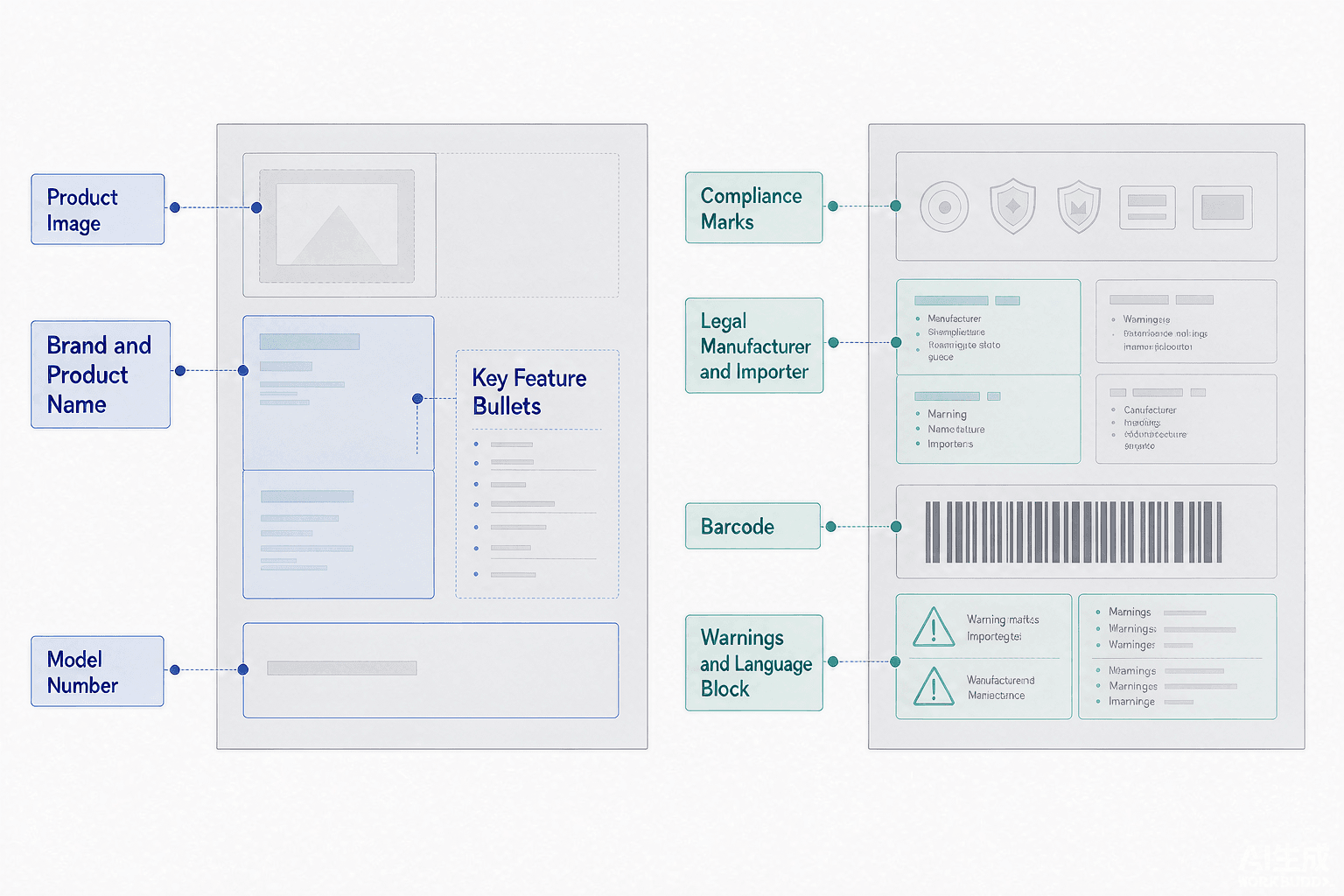
Requirements vary by market, but the following constitute the baseline for oral care electrical devices in most developed markets.
1. Main display panel (front)
- Product name and model
- Key technology claim (e.g., sonic frequency, pressure range) — only if verifiable
- Product image
- Core feature bullets (3–5 maximum; more becomes unreadable)
- Brand identity
One rule worth enforcing: never print a performance claim on the front panel that you cannot support with test data. "40,000 strokes/min" is fine if you can measure it. "10x cleaner" is a liability in most markets without clinical substantiation.
2. Compliance marks panel
The marks your device carries, correctly rendered. The critical detail is that each mark has requirements:
- CE mark — specific proportions, minimum size, must not be distorted. Cannot be applied to packaging alone without the underlying conformity documentation.
- EAC mark — required for EAEU markets, typically a minimum size specification.
- FCC — the statement "This device complies with Part 15 of the FCC Rules" plus the required interference statement is normally on the device or in the manual, not always on the box. Check the requirement.
- WEEE / crossed-out bin — required in the EU for electrical equipment, indicating it must not be disposed of as household waste.
- RoHS — usually a compliance statement rather than a mark.
- Battery disposal symbols — Li-ion and Ni-MH have specific disposal marking requirements in the EU.
Marks have proportions that cannot be stretched. This sounds trivial until a designer rebuilds the artwork and scales the CE mark non-uniformly — a predictable customs flag. Our certification guide covers what each market requires underneath these marks.
3. Legal manufacturer information
- Manufacturer name and registered address
- Country of origin
- Importer name and address (required in the EU — this is the single most commonly missed item)
- EU authorised representative, if applicable
The importer obligation catches out a great many non-EU brands: if you are selling into the EU through a distributor, the actual importer’s details must appear. Many brands design beautiful packaging, ship it, then discover they must over-label every unit at the warehouse.
4. Barcodes
| Barcode | Use | Notes |
|---|---|---|
| EAN-13 / UPC-A | Retail unit | Must be registered to your company’s GS1 prefix — not borrowed from your factory |
| ITF-14 | Shipping carton | Identifies the case, not the unit |
| GS1 DataMatrix | Emerging retail requirement | Some markets moving toward 2D codes |
| Serial / batch label | Traceability | Usually applied at production, not printed on the retail box |
The most common error: using the factory’s barcode prefix instead of your own. Retailers and marketplaces will reject a barcode registered to another company’s GS1 account, and retrofitting labels onto finished inventory is a costly mess.
Register your GS1 prefix before placing your first packaging order. This takes weeks in some countries.
5. Language block
Every market has language requirements. Minimums for common targets:
| Market | Required Language(s) |
|---|---|
| EU (general) | Official language(s) of the member state(s) of sale |
| Germany | German |
| France | French |
| Italy / Spain | Italian / Spanish |
| Russia / EAEU | Russian |
| US / UK | English |
Practical approach: design the panel with a dedicated language block that can be swapped between production runs, rather than one artwork carrying four languages. Multi-language panels are dense and often reduce compliance clarity — and they lock you into one version for all markets.
Ask your packaging supplier what the MOQ is for a language variant. Sometimes the answer is unhelpfully high; sometimes it’s surprisingly low.
6. Warnings and instructions
For an electrical device used in the mouth, warnings matter:
- Charging warnings (use only with supplied charger)
- Water immersion limits and IP rating statement
- Age restrictions (typically not for children under 3 without supervision)
- Battery warnings and disposal instruction
- "Not a substitute for professional dental care" — standard for oral care
- Choking hazard note for small parts, if applicable
Manual or box? Typically the summary warnings go on the box and the full manual is a separate printed booklet. That booklet is a compliance document — it must be in the right language, and it costs real money to fix after printing.
The Packaging Development Timeline
Most brands discover packaging too late. It has a longer lead time than they expect, and it must run in parallel with the product.
| Stage | Duration | Dependencies |
|---|---|---|
| Structural design (dieline) | 1–2 weeks | Product dimensions finalized |
| Artwork design | 2–4 weeks | Compliance marks finalized, barcodes registered |
| Language translation | 1–2 weeks per language | Artwork locked |
| Proofing and physical sample | 1–2 weeks | Artwork approved |
| Print production | 2–4 weeks | Proof approved |
| Assembly with product | 1 week | Both product and packaging ready |
Realistically 8–12 weeks from dieline to packed product. If you start packaging after your product is finished, you add two to three months to your launch — and this is exactly what happens on most first projects.
Sequencing advice: lock the product’s external dimensions early, then start the dieline immediately. Compliance marks and barcode registration should be in progress before the artwork begins, because both can block final artwork.
MOQ and Print Economics
Packaging minimums are frequently the binding constraint on your total order — higher than the product’s own MOQ. Understand the drivers:
| Cost Driver | What Affects It |
|---|---|
| Print setup | Number of colors, special finishes (foil, spot UV) |
| Board grade | Heavier board = higher cost but better retail feel |
| Die cut | A new die is a one-time cost; reusing an existing dieline is cheaper |
| Language variants | Each variant is a separate print run |
| Inserts / molded trays | Often the largest single packaging cost |
Two practical ways to manage it:
- Reuse a stock dieline where the product allows. A custom die adds cost and time for a shape the customer rarely notices.
- Print one language version in quantity, apply labels for others. A printed compliance label properly applied is acceptable in most markets and dramatically reduces MOQ per language.
The same volume economics that apply to device quoting apply here — see our MOQ, lead time and pricing guide for how packaging MOQ interacts with your overall order structure.
For consumables, packaging economics are even more significant relative to unit price — the consumables guide covers refill-pack specific considerations.
E-commerce vs Retail Packaging: Don’t Confuse Them
If you’re selling primarily on marketplaces (Amazon, Ozon, Wildberries), your packaging does a different job.
| Requirement | Retail (shelf) | E-commerce |
|---|---|---|
| Shelf impact | Critical — must catch the eye | Irrelevant |
| Photograph quality | Important | Critical — the listing photo is the product |
| Transit durability | Moderate — palette and truck | High — individual parcels, rough handling |
| Frustration-free / easy-open | Nice to have | Strongly preferred |
| Returns resilience | Moderate | Critical — a damaged box appears in customer photos |
| Selling point | Front panel design | Unboxing experience |
If you sell e-commerce-first: invest in carton strength and drop-test performance before front-panel design. A box that arrives dented generates returns and photos that damage your rating, regardless of how good the design is.
If you sell retail: the front panel and shelf presence are the priority, and the case pack matters for how retailers merchandise you.
Many brands need both. In that case, consider a retail box plus a separate shipper — which brings you back to the three-masters problem at the top of this article.
The Common Failures, in Order of Frequency
- Missing importer details for EU markets — discovered at customs or by the retailer
- Barcode registered to the factory, not your company — rejected by marketplace or retailer
- Language requirement missed for one of several target markets
- Compliance mark distorted during design revisions
- Packaging started after the product was finished — adds two months
- Warnings incomplete — particularly battery and charging warnings
- Retail packaging used as shipping packaging — arrives damaged, generates returns
Every one of these is preventable with a checklist applied at the artwork stage rather than the shipment stage.
The Bottom Line
Packaging is not artwork — it’s the compliance interface between your product and the market. Treat it as an engineering deliverable with its own lead time, its own dependencies, and its own approval gate.
Three actions to take before your next packaging project:
- Register your GS1 barcode prefix now — it takes longer than you expect
- Lock your product dimensions early so the dieline can start
- Confirm the importer-of-record details for every market you plan to sell into
Do these three things and your packaging will not be the reason your launch slips.
Besman manufactures electric toothbrushes and water flossers with OEM and ODM packaging support, including custom dielines, retail and e-commerce carton options, and multi-language artwork coordination. Contact us to discuss packaging for your target markets.